
Publications
2020
Francesca Tosi
The essay presents the educational offerings in Industrial Design and Design at Italian universities, discussing the most significant aspects and factors of competitiveness.

2020
Francesca Tosi
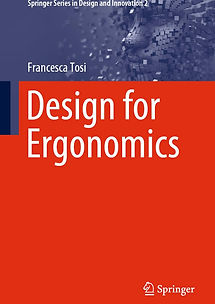
Ergonomics focuses on the interaction that people establish or can establish with the other elements of the system in which and with which they carry out their work and daily life activities. Interaction that takes place within a complex system, in which each element affects and modifies others, and of which people are an integral part with their characteristics, skills needs and expectations. The aim of ergonomics is to optimize, that is to improve at the highest possible level, both the well-being of people and the overall performance of the system, through evaluation and design interventions aimed at making compatible environments and systems with people’s needs, abilities and limitations. Ergonomics is therefore a complex approach to assessing and designing the interaction between people and the systems with which they relate, which focuses not on the quality of the system itself, but on the quality actually experienced from the specific group of people who relate to it, depending on their characteristics, abilities, needs, expectations, the activities they perform, and the set of variables (physical, technological, environmental, organizational, cultural) that may affect that relationship on a case-by-case basis. Essential, for the understanding of the relationship between ergonomics and Design and its evolution over time, is the definition of Human-Centred Design, today largely superimposed on the definition of Ergonomics, of which it represents the most recent component and closer to the culture and practice of the project.
2020
Mattia Pistolesi, Stefano Bellucci
The ICU are crowded with a variety of lung ventilators different from each other in terms of model, graphic interface, controls, management methods and functions made available to the operator. A regional study on the usability of mechanical ventilators involved 41 doctors of varying age and experience, 6 Tuscan hospitals and 17 models of pulmonary ventilators. The Post-Study System Usability Questionnaire (PSSUQ) was used to quantify the levels of usability. The results suggest a positive reliability of the observed pulmonary ventilators, so the utility of the system was the best considering the independent subscales, followed by user satisfaction, interface quality and information.

2020
Ester Iacono
When it comes to the healthcare system, it is not difficult to imagine how much anxiety, frustration, pain and many other feelings can arise when dealing with it. Often, even medical equipment (MRI scanners, ventilators, ultrasound machines, etc.) can make people feel threatened instead of positive. This is because of the focus on how stuff works and not paying enough attention to how the shape of things can send a message and how the healthcare environment can make people feel. These emotions are amplified if the patient is a child, who needs a healthcare system that takes into account their needs, feelings and opinions. Through the analysis of several case studies, the article illustrates: a) the contribution of emotional design within the paediatric-hospital context in reducing negative emotions and ensuring health and healing; b) the importance for designers to include emotions throughout the design process and influence the emotional impact of their projects.
2020
Francesca Tosi, Alessia Brischetto, Ester Iacono, Antonella Serra
In the wake of recent developments in the field of New Media Studies, Game Studies and Narratology, this essay aims to highlight some of principles useful to recognizing an educational simulation game when it is wellmade. Starting from the assumption that a game is a system based on rules and mechanics, and that their typology makes it more or less effective, more or less engaging and intense, more or less formative, the essay wants to analyze the principles related to content (narration) that are best suited to provide an appropriate simulation learning experience. For these reasons, the research analyzes of a selection of current educational Serious Games and compare their contents with the Procedural Rhetoric Theory (PRT) proposed by the game designer Bogost (2007). This theory identifies in the video game a system of rules and mechanics that is based on the rhetoric linguistic techniques of translated into a computational procedure. According to the PRT, games can exercise a good persuasion provided that the gameplay features a meaningful representation of this underlying procedure. To support these principles conceptually, the essay analyze also the pedagogical side of the contents and present some of the “36 Learning Principles” proposed by Gee (2007) will be used. This model proposes specific characteristics of each learning dimension and contributes to defines the principles of a wellmade learning experience. Considering the Serious Games analyzed through the lens of the PRT and the 36LP, the article aims to identify a series of rhetorical procedural principles relevant to the design of the educational content of a serious game.
2020
Francesca Tosi
The article deals with the role of design within the Ergonomics/Human-Centred Design approach by presenting the contents addressed in the special issue.
- 35Pagina 17